Output / Research Journal
Orchestrating intelligence
Note 6 from the research journal by Nicklas Lundblad: The fact that splitting an AI into multiple personalities sometimes gives better results than just asking the AI itself is deliciously weird, until you realize that this is sort of how our intelligence works as well - both individually and collectively.
Note 6.
Take a simple example: writing. Writing is essentially the art of splitting yourself into two different people – a writer and a simultaneous reader. The trick with writing is calibrating the two in such a way that the reader or critic does not stop the writer from exploring new ideas, charting unknown spaces and thinking through questions in depth. This is a delicate orchestrated process that evolution has honed over a very long time - starting with agency that folds on agency in different ways, and through that recursion splits us into many.
Most of what we do works this way, and it works even better when we work with others - to a degree. That is why designing teams is such an important, and honest, undervalued skill. A colleague once challenged me on what the first question should be to someone who had just been assigned a difficult task. One of my core weaknesses is that I am too prone to intellectualize things, and this showed in my answer: I said the first question should be how they understand the problem, what the diagnosis is. He, then, rightly said that that would be an ok question, but not the best one. The best one, he suggested, was: “who are you going to do this with?”.
The genius of this question is that it focuses the mind on the orchestration of problem solving, not the problem itself. And that is key to succeeding.
We sometimes still labor under the misconception that creativity and problem solving depend on the lone, romantic genius - but science, art and many other pursuits now depend on carefully orchestrated teams that work well together. And working well together does not mean agreeing – it means being able to fashion and create structured, productive disagreement in ways that help the end process. Good teams are kind, but never nice - they strive to make everyone grow with the challenge, but make no excuses or hold criticism back if it can advance the team towards the shared goal.
So, naturally the same applies to artificial agents.
This means that we should be thinking hard about orchestration as a key problem for agents, and try to understand what we can learn from organizational theory, psychology and sociology. There are a few interesting possibilities here and one is that all of human organization is useless for orchestration. We currently do not work under that assumption - when we orchestrate automated science teams we think in terms of regular research teams, for example - but it is one that we should explore. Just as artificial intelligences got better at playing go when you threw the human games out, we should expect that there are orchestrations that we have never explored for reasons that have to do with biological path dependencies.
Human chess and go represented local maxima and peaks in the fitness landscape for respective games, and seeding the AI with human games locked them into the same kind of local maxima. But when the exploration could happen entirely without human path dependencies, the results were very different - and chess masters and go masters both described the experience as witnessing an “alien” playstyle. There may well be superior “alien” organizational forms as well!
One of the fundamental questions of orchestration - at least naively - seems to be something like:
(i) For problem X, what orchestration O of agents (a(1)...a(n)) is the optimal orchestration?
In this question each agent has their own set up, configuration and perhaps even data, in order to create the kind of tension that we want to work through. Now, it immediately seems obvious that the space of possible orchestrations, let’s call it O-space - is very large – and multi-dimensional. How can we best describe it?
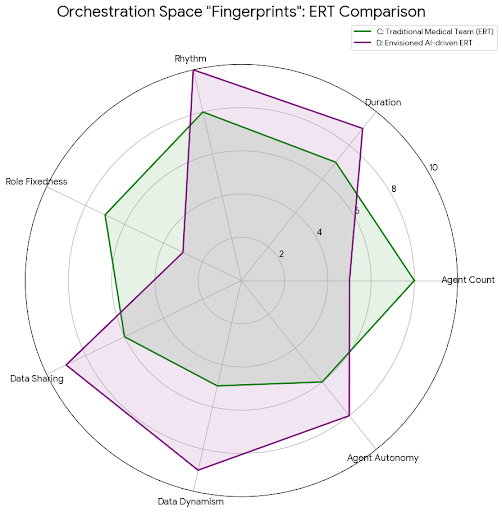
O-space is both about the configurations of agents and the dimensions of the agents themselves. Orchestrations can be configured in number of agents, time (both rhythms of intervention and duration of engagement), roles (both what the function of the agent in the orchestration is and the fixedness of this function (do agents shift roles?)) and data space (shared, fragmented, evolving, static etc).
Plenty of different taxonomies have already been suggested for the agents in our orchestrations - and as we noted earlier each such taxonomy needs to be relative to a particular domain or use case. Here a good taxonomy of agents relative to O-space could be constructed along at least three interacting axes: epistemic diversity, temporal structure, and degree of coupling.
Epistemic diversity describes how differently the agents see the world — whether their priors, data, or reasoning styles are orthogonal, overlapping, or incommensurable. In human teams this might mean pairing an economist with a poet; in artificial teams, a symbolic reasoner with a large-scale pattern-matcher. Temporal structure refers to how and when the agents interact: some orchestrations might rely on simultaneous, symphonic interplay, others on call-and-response forms more akin to jazz improvisation. Finally, coupling captures how tightly the agents share state — whether they operate as loosely aligned semi-autonomous units, like a flock of birds, or as a single organism with distributed cognition, like a slime mold.
If we plot these three axes, we can begin to imagine topographies of O-space: regions where certain forms of intelligence cluster, ridges where coordination costs rise steeply, and valleys where emergent insights appear spontaneously.
To explore this landscape systematically, we might use orchestration search algorithms — meta-learners that design, test, and evolve new coordination patterns among agents. In a sense, these would be “conductors of conductors,” systems that experiment with the very grammar of collaboration. The resulting alien organizations might bear as little resemblance to human ones as AlphaZeros's style does to 20th-century playbooks. They may also - equally important - show us when orchestration does not work (or, to put it differently: which pieces require solo-orchestration), as pointed out in a recent research paper.
We may need new metaphors and models for these new forms of organization - like dreaming committees (exploring the vast graph of analogies), predators (eating ideas that are weak or slow) and immune systems (building on experience of bad projects from the past). We will need taxonomies of orchestrations as well – much as we think about real orchestras: symphony orchestras, quartets, jazz bands – each adapted to a musical style and performance. This in itself will be a key research project, I think, and orchestration is also very likely to be a key regulatory lever: which orchestrations will we require for which tasks?
Organization and biology might converge - if we believe that evolution has charted the optimal territories of O-space. Evolution is after all an orchestration engine: it endlessly reconfigures agents — genes, cells, organisms, societies — in search of adaptive fit. The principles under which it does so are miserly and constrained, however, so there may be entirely new ways in which we can orchestrate intelligence.
In that sense, the skill of orchestration may turn out to be a new frontier of creativity — not what ideas we generate, but how we arrange the hybrid intelligences that generate them.
If creativity is a kind of search, the orchestration is the organization of the search party for the vast open landscapes of the knowable universe.