German Universities Have a New Answer to the Research-to-Impact Gap
Catalyst GER Launches Its First Cohort
While tech spin-offs and start-ups have well-worn paths from lab to market, researchers working on democracy, public health, urban life, and inequality develop outstanding answers to pressing questions every day — but too often, those ideas never leave the journal article. The infrastructure to carry social science research into the real world has simply been less established. Until now.
About Catalyst GER
Catalyst GER is a structured incubator programme for researchers in the social sciences, humanities, and arts who want to take their work beyond the journal article. Developed by Kindling Ventures and modelled on a well-established UK programme, it provides researchers at all career levels with the skills, tools, and network to scale their impact through many different pathways, where building a startup is only one possible outcome.
The programme launches its first cohort in March 2026, bringing together researchers, postdocs, and doctoral candidates across eight German universities: Ruhr University Bochum, TU Dortmund University, University of Duisburg-Essen, Heidelberg University, Kiel University, University of Cologne, University of Stuttgart. TUM is among them and the majority of TUM's participants come directly from the TUM Think Tank's own network of labs, fellows, and researchers here at the Munich School of Politics and Public Policy and the TUM School of Social Sciences and Technology.
How it works
Catalyst GER guides participants through three stages, designed to meet researchers wherever they are in their thinking. The programme begins with an online course giving researchers an overview of different knowledge transfer pathways and the tools to pursue them. Teams with a concrete project can then apply for the second phase, intensive workshops open not just to start-up founders, but equally to teams developing consulting offers, training programmes, or new initiatives. The most promising teams is awarded the TUM SHAPE Impact Award and receives particularly intensive support in the third and final phase. The goal throughout: turning good research into real-world impact, whether that's a policy shift, a community tool, a partnership, or something else entirely.
The kick-off
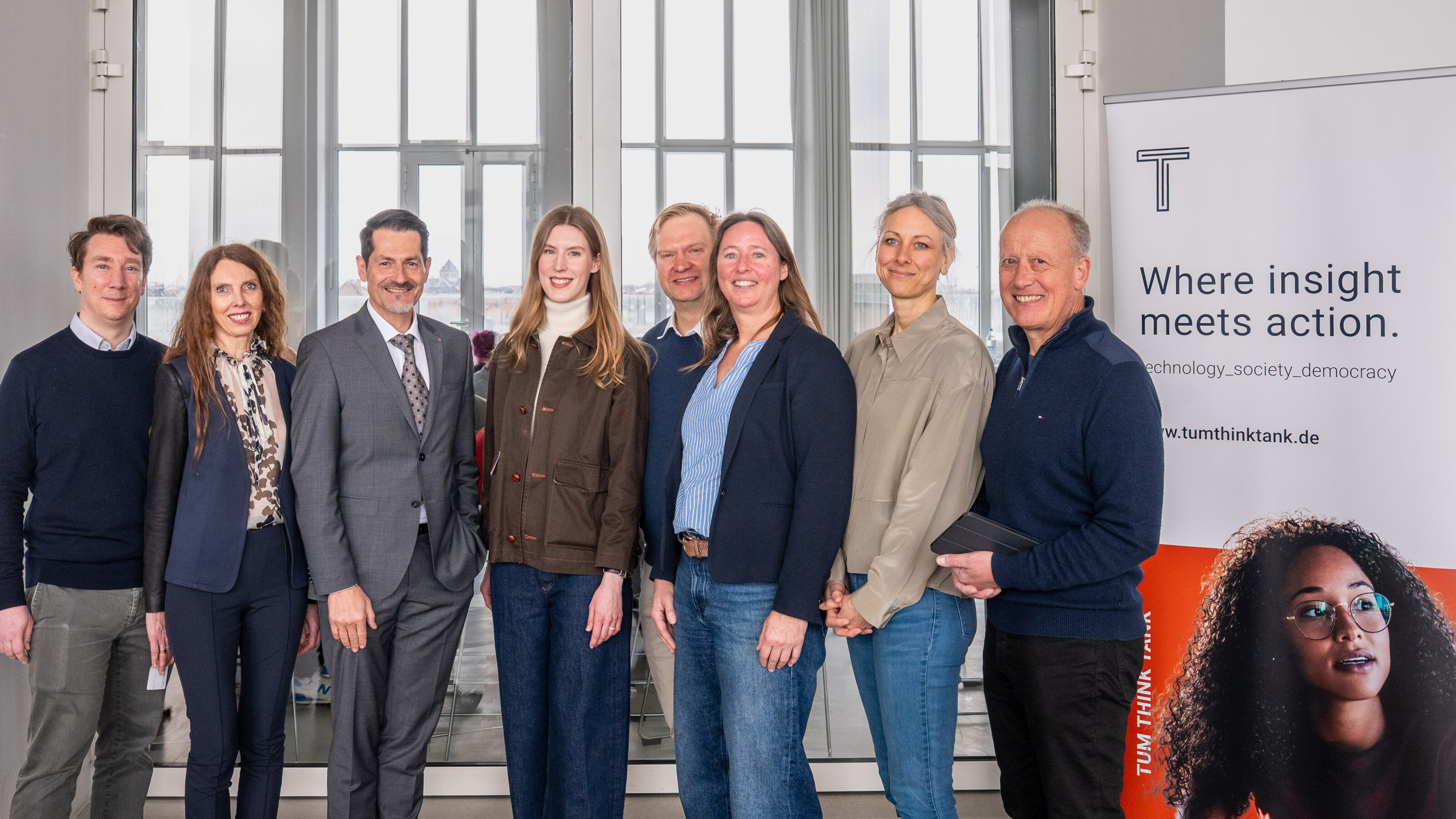
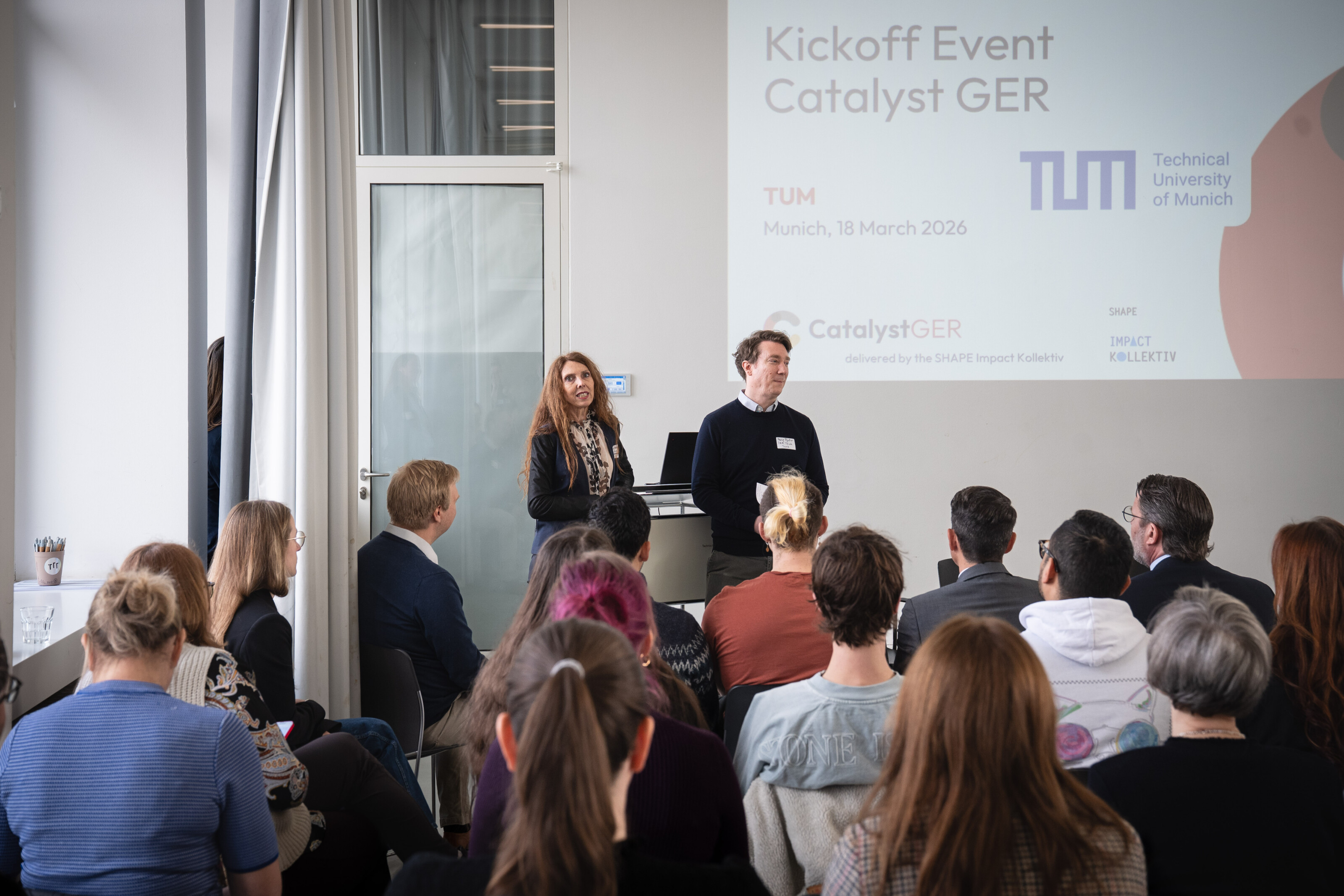
On March 18, the launch event brought together researchers, university leadership, and external partners, and the energy in the room made clear this is hitting a nerve. “We look forward to building new bridges between academia, society, and the public sector and to collaborate with public institutions, NGOs, policy makers, and social enterprises to ensure that knowledge generated at universities has a real-world impact,” says TUM President Thomas Hofmann. “This is a key part of our TUM AGENDA 2030+, which has just been selected as a winning strategy in Germany’s University of Excellence competition.”
Urs Gasser, dean of the TUM School of Social Sciences and Technology, was equally enthusiastic and highlighted what researchers themselves stand to gain: engaging beyond academia creates feedback loops that sharpen research and open up questions no paper alone could surface.
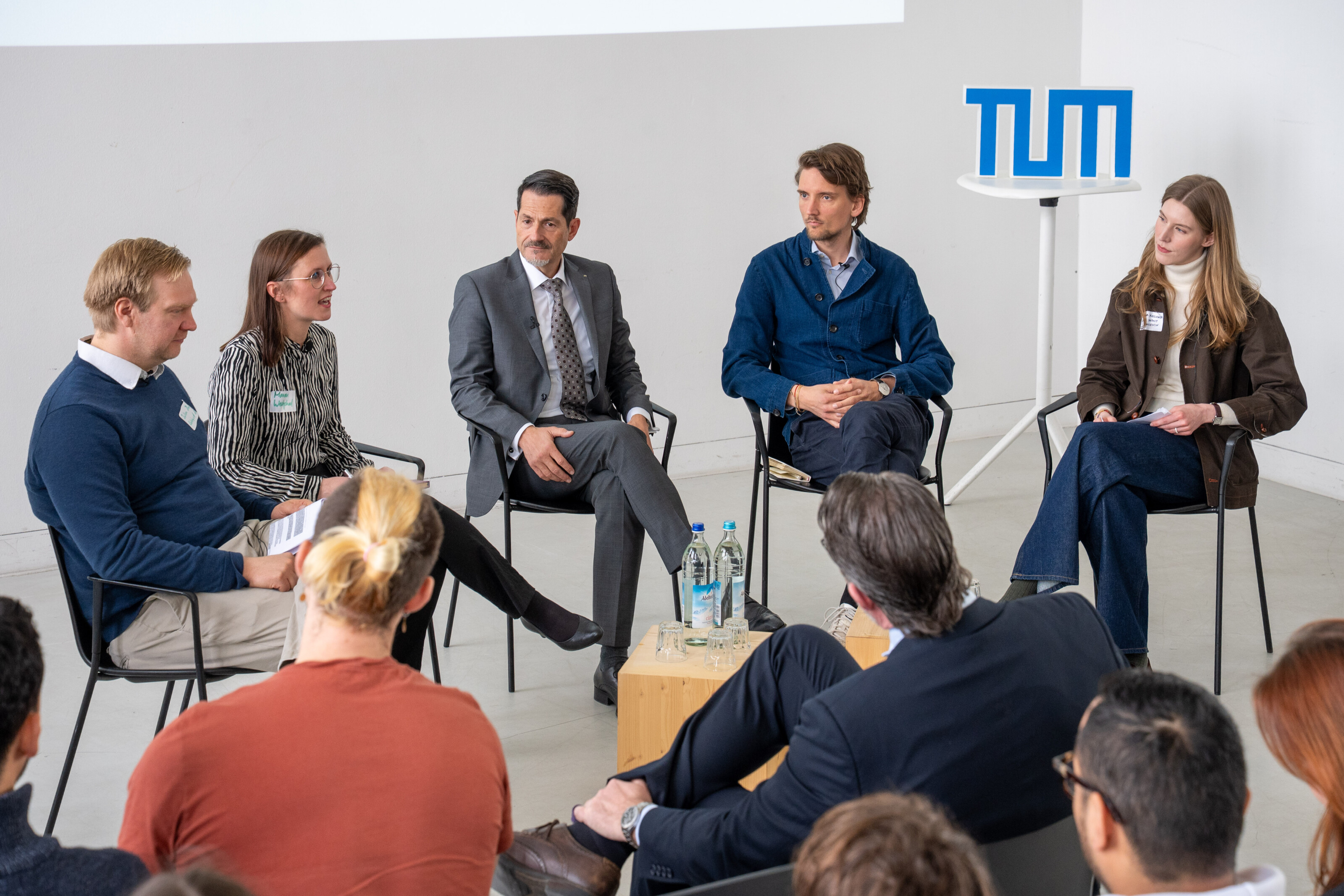
The panel sharpened the argument: social sciences belong at the beginning of innovation pipelines, not the end. Manon Westphal, who leads our Democratic Innovations Lab, is developing a tool to help practitioners navigate the design choices behind innovations like citizens' assemblies. Florian Egli, head of our Transformation Finance Lab, drew on his work with the City of Munich, navigating a complex multi-stakeholder process where building willingness to pay for innovations is itself a social innovation. His advice: “These things don't grow on paper. Be a role model, see how far you walk.”
c: Andreas Heddergott
c: Andreas Heddergott
c: Andreas Heddergott
A Natural Fit for the TUM Think Tank’s Mission
A core part of the TUM Think Tank's mission is ensuring that research can translate into practice. We worked alongside TUM Entrepreneurship to initiate TUM's participation and to recruit the first cohort, drawing almost entirely from our network of labs, fellows, and researchers at the Munich School for Politics and Public Policy and the TUM School of Social Sciences and Technology. That so many of them were ready and eager to participate is itself telling: the appetite for this kind of support has always existed, the infrastructure just had not.
As Philip Pfaller, Innovation Manager at the TUM Think Tank, puts it: "Many of our researchers are already working to bring their insights into practice. With Catalyst GER we start building the infrastructure to support them — so that social innovation gets the same institutional backing that technology transfer has had for years."
What comes next
The programme runs through 2026. Participants will move through the three stages at their own pace, with the TUM SHAPE Impact Award opening the pathway to more intensive support for the strongest emerging projects. The TUM Think Tank will continue to support its community members throughout and we'll be sharing updates as the cohort progresses.
"Many of our researchers are already working to bring their insights into practice. With Catalyst GER we start building the infrastructure to support them — so that social innovation gets the same institutional backing that technology transfer has had for years."
- Philipp Pfaller, Innovation Manager (TUM Think Tank)