Output / Publication
The Evolution of the G20 Digital Agenda
The TUM Think Tank is part of an international partnership that has formally handed over a landmark policy report tracing the evolution of the G20’s digital agenda to South African government partners.
Global digital governance faces a structural challenge: memory loss. Policy priorities evolve rapidly, but institutional memory does not automatically carry over between cycles. Within the G20, this challenge is particularly visible — each presidency advances the digital agenda in important ways, yet insights, frameworks, and lessons learned risk being diluted, changed or re-interpreted once the presidency changes.
Our latest report “The Evolution of the G20 Digital Agenda” addresses exactly this gap. It offers a synthesised analysis of how the G20's digital agenda evolved across the presidencies of Indonesia (2022), India (2023), Brazil (2024), and South Africa (2025), tracing continuities, shifts, and tensions across three pillars: digital transformation, digital public infrastructure (DPI), and artificial intelligence (AI).
Three pillars, four presidencies
Digital transformation evolved from a focus on access to an emphasis on inclusion and impact. Indonesia's people-centred post-pandemic framing gave way to India's integration of connectivity into DPI and skilling frameworks. Brazil introduced measurable quality benchmarks under a vision of universal and meaningful connectivity, while South Africa advanced a framework for equitable digital inclusion, with attention to small business ecosystems and non-infrastructural barriers such as energy access and digital safety.
DPI matured from a background set of enablers into a cornerstone of the G20 agenda. India formalised DPI through a dedicated framework built on technology, governance, and community. Brazil added rights-based governance safeguards. South Africa introduced a Public Value Measurement Framework to assess the tangible socio-economic benefits of DPI investments.
AI governance progressed from a subcomponent of digital transformation to a central developmental priority. India advanced principles for safe, human-centric AI aligned with the SDGs; Brazil framed AI through equity and human rights; South Africa reinforced this trajectory with the AI for Africa Initiative and the Technology Policy Assistance Facility, focusing on computing access, representative datasets, and sovereign AI capabilities for the continent.
The findings show an unusual degree of continuity across presidencies — with each year building on the foundations of the last.
From analysis to institutional memory
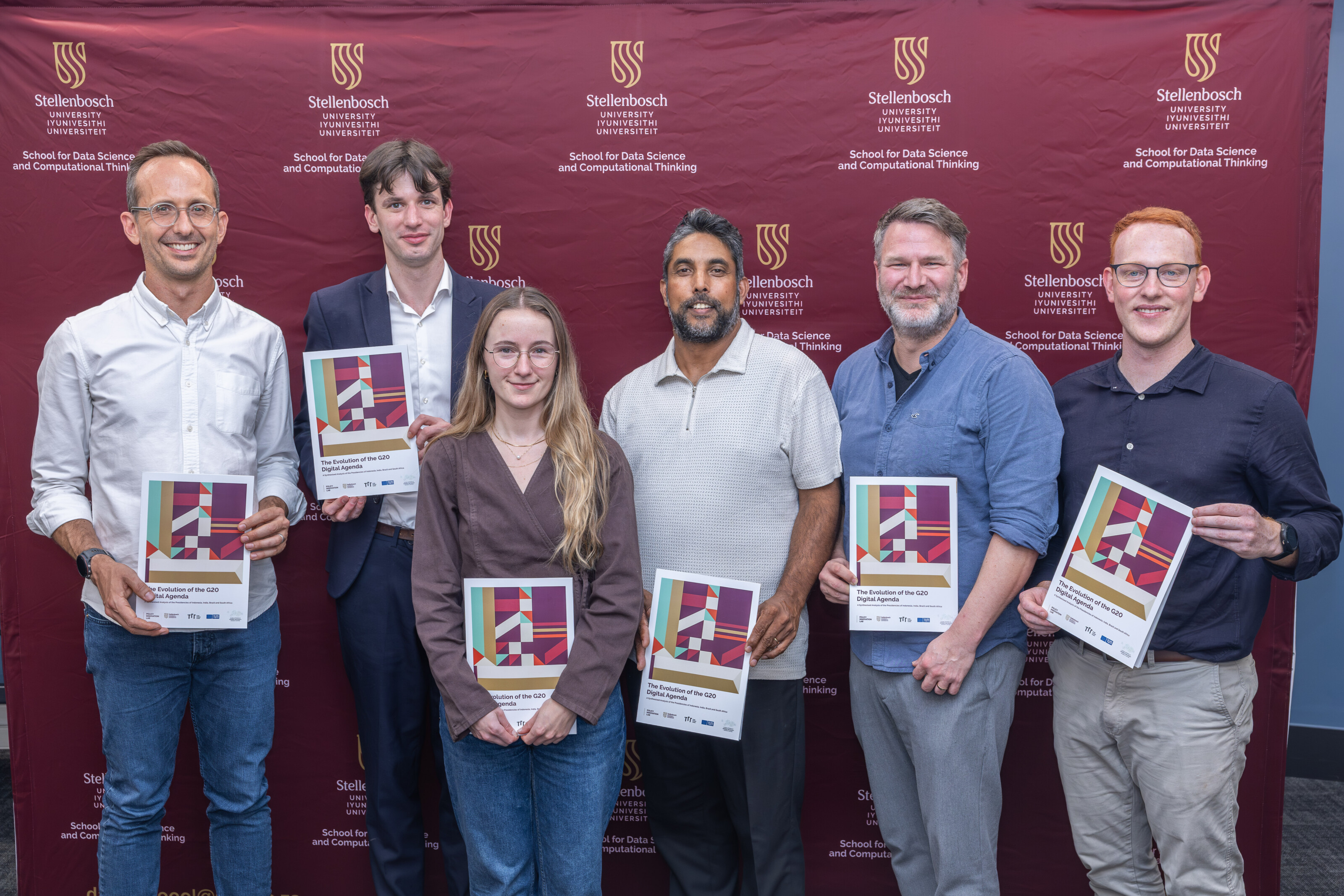
On 26 January 2026, the report was formally handed over to officials from South Africa's Department of Communications and Digital Technologies and members of the G20 Digital Economy Working Group — marking its transfer from research into active policy use. The event was hosted by the Policy Innovation Lab at Stellenbosch University, in collaboration with the TUM Think Tank and the Global Network of Internet & Society Centers (NoC).
We cannot overestimate the importance of trusted partnerships across national boundaries, particularly between Germany and South Africa, to enable impactful and coherent policymaking in this era of radical change — Markus Siewert (Managing Director of the TUM Think Tank)
With rapid technological change, growing geopolitical fragmentation, and increasing demands on the G20 to deliver concrete outcomes, institutional memory and policy continuity are no longer optional — they are prerequisites for credible multilateral cooperation.
Policy Innovation Lab and TUM Think Tank, The Evolution of the G20 Digital Agenda: A Synthesises Analysis of the Presidencies of Indonesia, India, Brazil and South Africa (2026). Edited and refined by J. Haw, F. Sauca, A. Molnar, A. Khan.