
Output / Research Journal
The future of a decision
When working with foresight projects it quickly becomes apparent that what we focus on matters. Just focusing on the future in general is sometimes exciting, because it allows us to explore the broad spectrum of possibilities that tomorrow brings - but it also means that we sacrifice specific insights for broad brush perspectives.
Note 3: When working with foresight projects it quickly becomes apparent that what we focus on matters. Just focusing on the future in general is sometimes exciting, because it allows us to explore the broad spectrum of possibilities that tomorrow brings - but it also means that we sacrifice specific insights for broad brush perspectives.
An alternative is to focus on something specific - like the way a budget will change, or how the origin of tourists to a city might change. Such foresight projects are more focused and can often provide more actionable results. One variation on this approach is to look more closely at a decision and a decision maker.
Note 3.
Asking how a decision will be made in the future and who will make it is often a great frame. Let’s look at an example: say you build and deliver boats for navies around the world. In this case there is a very real decision you care about in the future: the procurement decision that a country needs to make when it wants to buy new frigates, say. How such decisions will be made, and who will make them, is key to the way you design the boats, contracts and partnerships that you hope will lead the procuring nation to pick your boat.
Modelling decisions requires breaking them down into subcomponents and then weighting these in different ways. Just engaging in that process will often be eye-opening, as we discover the real complexity of a decision and are forced to figure out how we think the decision maker will act. It fosters what we can call “outside-in”-thinking, ensuring that we see ourselves as others see us, and not as we think we are.
In fact, you could argue that if you understand the decisions that will be made about a company in the future, and if you know how they will be made - with some greater precision than before - then you have a pretty awesome competitive advantage.
Decision modelling has a long and contested history. The orthodox lineage runs through Ronald Howard's decision analysis school at Stanford in the 1960s, the multi-attribute utility theory of Keeney and Raiffa, and the later "decision quality" movement of Spetzler and Matheson — all of which assume that a decision can be usefully decomposed into weighted attributes and evaluated against expected utility. This is the tradition our frigate example sits within. But the tradition has been challenged from several directions, and the challenges are worth taking seriously.
Herbert Simon argued that decision makers satisfice rather than optimize, bounded by cognitive limits and the cost of search. James March and his collaborators went further, describing organizational decisions as garbage-can processes where problems, solutions, and decision makers collide somewhat randomly in temporal streams. Gary Klein's work on recognition-primed decision making showed that experts in high-stakes domains — firefighters, military commanders, ICU nurses — rarely weigh attributes at all; they pattern-match against accumulated experience and run mental simulations of the first workable option. Gerd Gigerenzer's fast-and-frugal heuristics tradition has shown, perhaps inconveniently, that simple lexicographic rules ("take the best") often outperform weighted models in real environments.
And then there is the political-science critique: Allison's three models of the Cuban missile crisis, Baumgartner and Jones on punctuated equilibrium, the whole tradition reminding us that decisions are made by coalitions in venues, and that venue migration often matters more than weight reshuffling. So why model at all? Because — and this is the move worth making explicit — the critiques themselves are modellable. A satisficing decision is a decision model with an aspiration threshold and a stopping rule. A recognition-primed decision is a model with a single dominant pattern-match coefficient and near-zero weights elsewhere. A garbage-can decision is a stochastic model over a coupling matrix of streams. A coalition decision is a weighted model where the weights are themselves negotiated outputs of a prior bargaining model. The point of decision modelling, in foresight at least, is not to claim that real decisions look like tidy MAUT scorecards — they usually don't — but to make our assumptions about how the decision is being made explicit enough to be challenged, reweighted, and forecast forward. The orthodox model is one starting point; the heterodox critiques give us others. What matters is that we pick a model, name it, and then ask the genuinely interesting question: how will the model itself change?
Once we have the decision modelled we can start working out how we think the decision model might change: will some considerations become more important? Will others fade? Are new factors entering the equation? And who will be making the decisions in the future? Let’s look at what it could look like for our boat manufacturer in a simple toy AI-tool using the standard decision model framework.
First we describe the decision we are interested in:
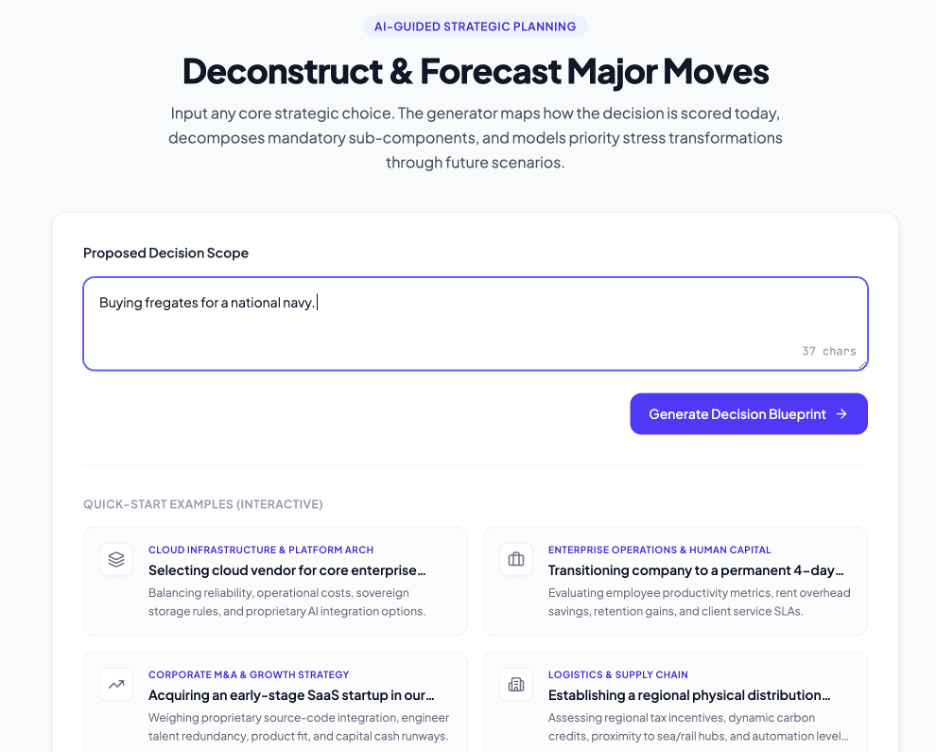
Then, next we look at the present day decision model:
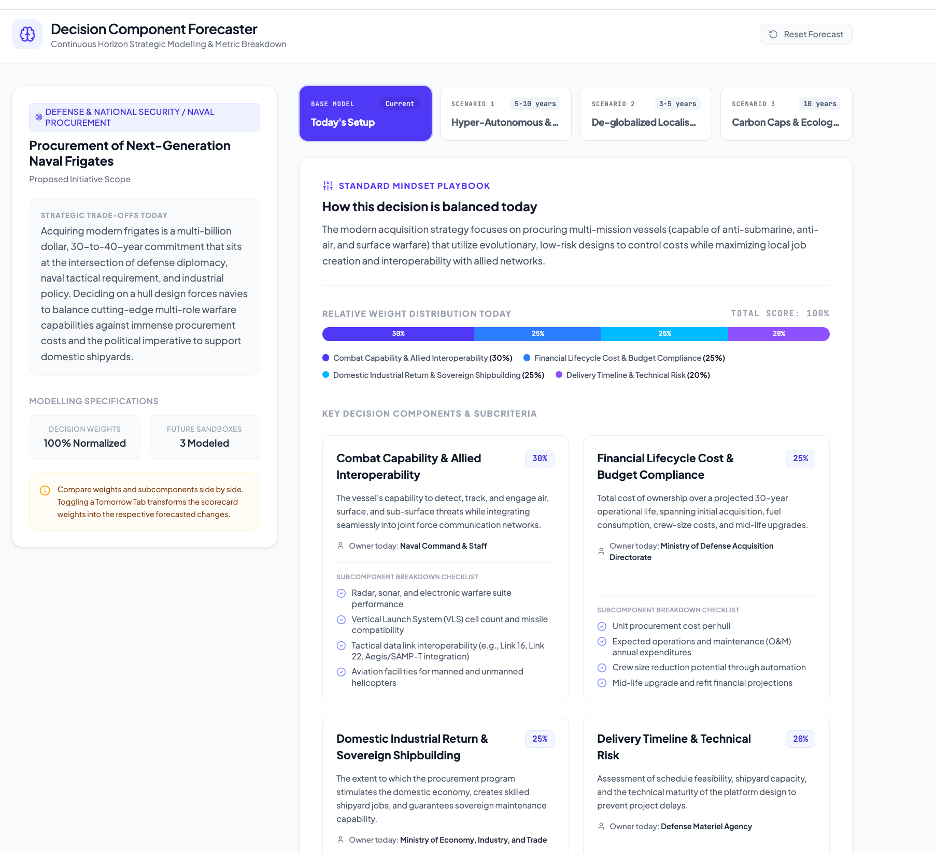
We get a whole set of decision components and subcomponents that we can look at and evaluate. We can also explore the weighting to see what we think is reasonable - and then we can look across scenarios for how the decision model changes:
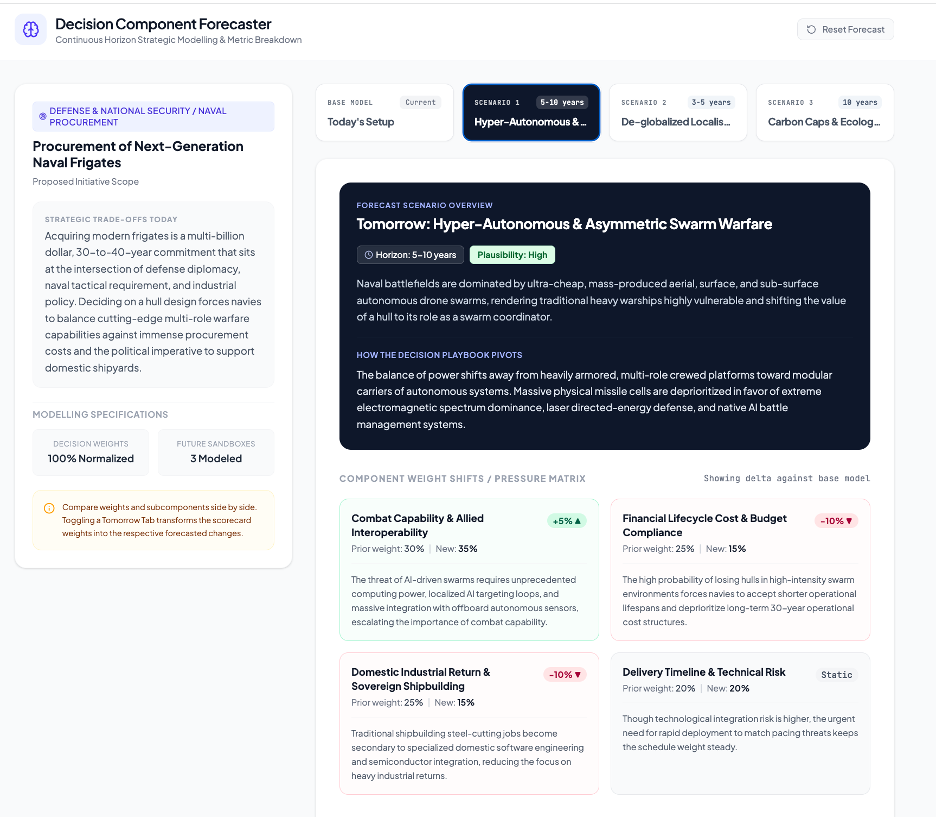
Here we also find entirely new considerations:
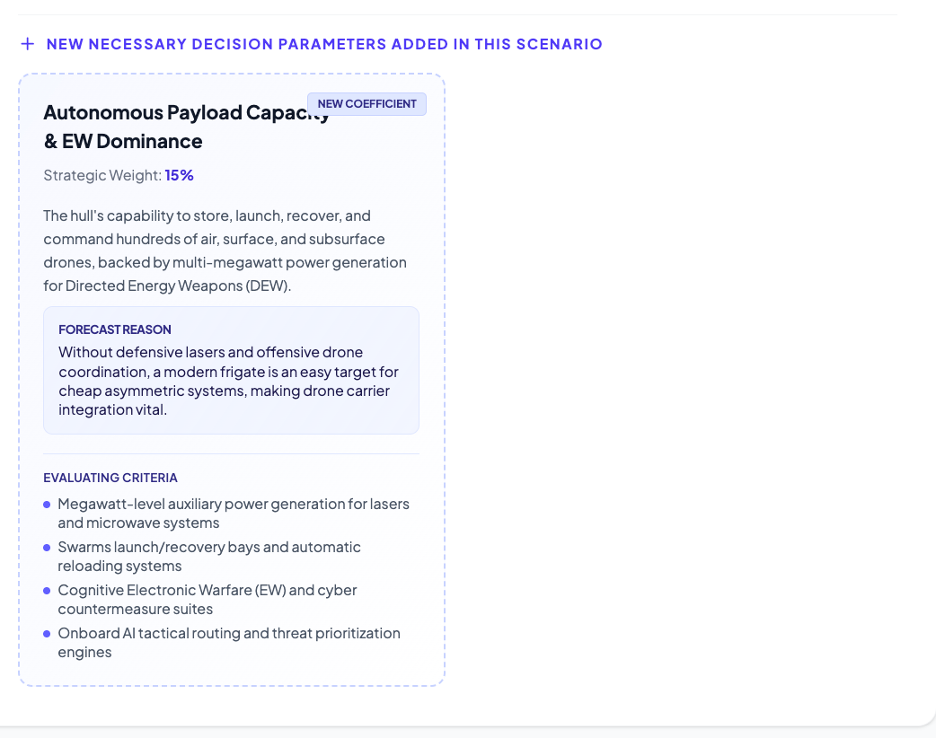
And we can then go on, tweak and explore the scenarios to see how the decision changes.
Decision modeling is, of course, a well-known methodology - but what we are adding is the idea that we can forecast how decision models change. This means that we use the decision as a focal lens for our foresight work, hopefully making it directly relevant to the organization we work for.
Your future, after all, relies to a great extent on the decision others will make about you.
Further reading/notes
The orthodox decision-analytic tradition
Howard, Ronald A. and Abbas, Ali E. Foundations of Decision Analysis. Pearson, 2015. — The canonical modern textbook of the Stanford school; Howard's earlier papers from the 1960s established the field.
Keeney, Ralph L. and Raiffa, Howard. Decisions with Multiple Objectives: Preferences and Value Tradeoffs. Cambridge University Press, 1993 (orig. 1976). — The foundational text for multi-attribute utility theory.
Spetzler, Carl, Winter, Hannah, and Meyer, Jennifer. Decision Quality: Value Creation from Better Business Decisions. Wiley, 2016. — The practitioner-oriented synthesis of the "decision quality" movement.
Savage, Leonard J. The Foundations of Statistics. Wiley, 1954. — For those wanting the deeper philosophical roots in subjective expected utility.
The bounded-rationality and satisficing critique
Simon, Herbert A. Administrative Behavior. Free Press, 4th ed., 1997 (orig. 1947). — The originating critique of optimization-based decision theory.
Simon, Herbert A. "A Behavioral Model of Rational Choice." Quarterly Journal of Economics, 1955. — The short paper where satisficing is introduced.
Organizational and political models
March, James G. and Olsen, Johan P. Ambiguity and Choice in Organizations. Universitetsforlaget, 1976. — The garbage-can model in its developed form.
Cohen, Michael D., March, James G., and Olsen, Johan P. "A Garbage Can Model of Organizational Choice." Administrative Science Quarterly, 1972. — The original paper.
Allison, Graham and Zelikow, Philip. Essence of Decision: Explaining the Cuban Missile Crisis. Longman, 2nd ed., 1999. — The three-models framework; indispensable for thinking about institutional decisions.
Baumgartner, Frank R. and Jones, Bryan D. Agendas and Instability in American Politics. University of Chicago Press, 2nd ed., 2009. — Punctuated equilibrium theory and the role of venue shifts.
Naturalistic and heuristic decision making
Klein, Gary. Sources of Power: How People Make Decisions. MIT Press, 1998. — The accessible introduction to recognition-primed decision making.
Gigerenzer, Gerd and Todd, Peter M. Simple Heuristics That Make Us Smart. Oxford University Press, 1999. — The fast-and-frugal research programme.
Gigerenzer, Gerd. Gut Feelings: The Intelligence of the Unconscious. Viking, 2007. — A more readable entry point.