
Output / Research Journal
Anticipation and prediction
Note 1: This is the first note in a new series of research journal notes. This journal will be focusing on foresight and futures studies, and specifically on how we can update our methods and tools using different cognitive technologies.
Note 1.
This is the first note in a new series of research journal notes. This journal will be focusing on foresight and futures studies, and specifically on how we can update our methods and tools using different cognitive technologies. The series reflects a change in the direction of the fellowship I am doing at TUM Think Tank, and I hope it will be interesting to follow!
How do we define the function of foresight? Here is one possible attempt: all foresight techniques and methods are cognitive tools meant to help you change your mind in meaningful and beneficial ways. If you speak about the future in general terms, observing it or just noting it you are then, strictly speaking, not engaged in foresight. This suggests that there is a difference between mere prediction and anticipation.
One crisp way to situate that distinction is to say that this is the difference between the future as it appears in physics and biology. Physics predict future states of the world, whereas biology seeks to anticipate the world. The etymology of the two words is helpful here: prediction is pre-declaring, saying, something about the world, but anticipation has a different meaning.
The word anticipation descends from the Latin verb anticipare, meaning "to take before," "to take beforehand," or "to seize in advance." It is a compound built from two transparent elements: the prefix ante- ("before") and the verb capere ("to take, seize, grasp"). The literal sense, then, is something like fore-taking or to have already laid hold of a thing before its proper time.
Capere is one of the great generative roots of the Latin lexicon. It gives English an enormous family of words concerned with grasping, both in the physical and in the cognitive sense: capture, captive, capable, capacious, conceive, perceive, receive, deceive, accept, except, intercept, participate, emancipate, occupy, recover. The shared thread is the hand closing around something and, by a very old metaphorical extension, the mind closing around a thought. To conceive an idea and to catch a ball are, linguistically, the same gesture.
Anticipating the future, then, is something like grasping it, seizing it and acting within the futures you anticipate. Catching the future.
A lot of foresight techniques have implicitly started with an idea of the future that is closer to the physics one than the biological one. As we now seek to update the library of older methods to engage with the future (all still valid and useful, to be clear) we can do far worse than to look to biology for inspiration, models and new research areas.
Let’s take an example: what notion of the future does a tree have?
At first you might reject this as a nonsense question, since having a notion of the future requires you having to be able to think and trees do not, strictly think, but this reveals another prejudice that colors our work with the future. This prejudice is one that is deeply rooted in us, and it is simple: we overvalue cognition.
This is just natural: we believe thinking is great because we think. Look at all what we have accomplished and where we stand in the world: we are clearly the most powerful species alive, and our cognitive capabilities are key to our rise to power. We do not overwhelm our natural enemies with force or poison, we vanquish them with thought.
This is right. Cognition is very powerful. It is, however, also very metabolically expensive. It takes a lot of energy to think, and the brain consumes almost 20 percent of our energy. And there are a lot of systems around us that anticipate the future without necessarily thinking. One of the most obvious ones is evolution - a wholly a-cognitive system of problem solving, and arguably the most powerful we have.
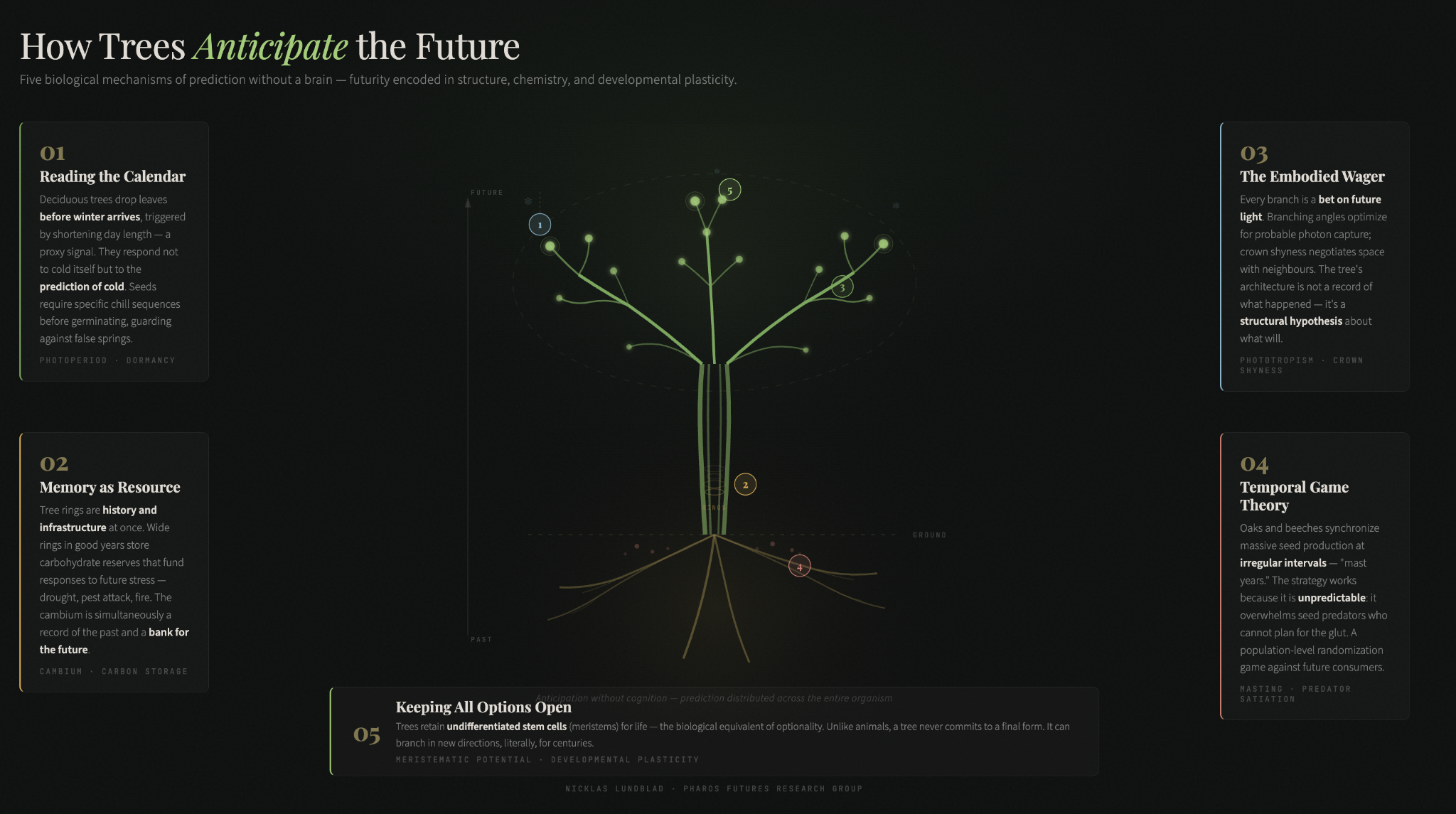
Fitness often depends on foresight - on being able to change and adapt to circumstances as they shift. Being able to anticipate the future is a way to survive the changes that it brings, and so we should not be surprised to see that organisms all around us have different non-cognitive representations of the future. Let’s get back to our tree: every branch is a bet on where the light will be, how the winds will move, the robustness of the trunk. When the days get shorter trees that shed their leaves knows that this is a proxy for colder weather, and the tree keeps meristemic cells that can evolve into anything in store for eventualities, creating optionality for the organism in uncertain times. Trees have a myriad of ways to anticipate the future, and this matters for their survival and darwinian fitness.
So, why does this matter for us when we want to explore foresight and new possible models for futures studies? The answer is deceptively simple: our minds were made for anticipatory foresight, they are products of the same evolutionary processes that creates a tree’s notion of the future. If we want to build foresight tools that really change our minds, then, we should start thinking about our minds as anticipatory, ready to grasp the future in different ways, and not just predictive in the more narrow sense - and we should build tools that structure and strengthen our ability anticipate the future in different ways, and perhaps concentrate less on mere prediction. The study of biological futures is a great way to start.