
Output / Research Journal
Invariances and trends
Note 2: A lot of foresight is about forecasting trends, and with trends we mean change. In all of our engagement with the future we most often begin asking “what is changing?”. The reason for this is straightforward: we want to prepare for that change, and try to understand how it will affect us, our organization and our future overall.
Note 2.
A lot of foresight is about forecasting trends, and with trends we mean change. In all of our engagement with the future we most often begin asking “what is changing?”. The reason for this is straightforward: we want to prepare for that change, and try to understand how it will affect us, our organization and our future overall. Some of these trends are large and unfold over decades, and we call these megatrends. Demographics, technological advances, geopolitical shifts…the list is long and every foresight expert worth their salt will have their set of trends and their numbers that illustrate them. Within specific domains we look at how markets develop, or how companies change - and these are, then, I supposed, microtrends. Changes, but not as global and all-encompassing. Microtrends are often relevant to certain domains, industries, geographies and polities.
But what if we looked at what doesn’t change at all? Let’s say you were invited to a foresight seminar on Megainvariances - would you go? These invariances are things that will stay largely the same or shift only a little over the coming 20 years or so, and they will provide the static background against the change wrought by the megatrends, but they are a lot less popular to think about, and, indeed, most people would probably not feel very excited about a seminar that stated what would remain more or less exactly the same over the coming two decades.
That may be a mistake, however. Invariances - both mega and micro - are key to understanding the future, exactly because they do not change. Any change that happens has to happen within these systems, and the invariances, taken together, represents the incredibly important inertia that all complex systems exhibit. Some of this inertia is born out of the complex system’s tendency to seek homeostasis, an equilibrium of forces, and some is born out of the system's incumbent forces reducing the impact of change.
What are some examples of such invariances?
What are some examples of such invariances? Here are a few candidates. In examining them you immediately realize that there is another reason we should list them: it allows us to really challenge them and explore if they really are invariant after all.
- In 20 years we will have the same number of countries in the world that we do now, no more than 3-4 countries will be added or disappear.
- In 20 years the largest, most valuable public companies will still be American.
- In 20 years the US will still spend more on defense than the next 10 countries.
- In 20 years fossil fuels will still represent more than 60 percent of the global energy mix.
And we can become even more detailed and point out some other cases, that are much broader and more interesting:
- Human time use. In 20 years, the average person will still sleep roughly 7–8 hours, commute 25–35 minutes each way, and spend about 1 hour eating. Time-use surveys across decades and cultures show astonishing stability here. Marchetti's constant — the observation that humans across cultures and centuries spend about an hour a day in transit — is one of the most underappreciated invariances in urban planning, and it's survived horses, trains, cars, and remote work.
- Language distribution. In 20 years, the top 10 most-spoken languages will be the same 10, in roughly the same order. Mandarin, English, Hindi, Spanish, Arabic don't rearrange on 20-year timescales even though we keep being told translation AI will flatten everything.
- City rank-size distribution. In 20 years, the rank-size relationship of cities (Zipf's law) will still hold, and the top 5 cities in most large countries will be largely unchanged. Cities are extraordinarily sticky — Rome, Istanbul, Cairo, Damascus have been top-tier urban centers for millennia.
- The shape of corporate hierarchies. In 20 years, the typical organizational span of control will still be 5–9 direct reports, and large organizations will still have roughly 6–8 layers between CEO and front-line. We've been promising flat organizations since the 1980s. Doesn't happen.
- The university as institution. In 20 years, the top 20 universities globally will overlap by at least 16–17 institutions with today's list. Harvard, Oxford, Cambridge, MIT have held position through the printing press, industrialization, and the internet.
- Religious adherence. In 20 years, more than 80% of the world's population will still identify with a religious tradition, and the global ranking of major religions by adherent count will be unchanged. Secularization narratives consistently overstate.
- Reading speed. In 20 years, humans will still read at roughly 200–300 words per minute. This is a hard biological floor that no technology has moved despite a century of speed-reading promises.
- The 90-9-1 rule of online participation. In 20 years, the vast majority of content on any participatory platform will still be produced by a tiny minority of users.
- Marriage and partnership. In 20 years, the majority of adults globally will still pair-bond into long-term partnerships, and the median age of first marriage in developed countries will continue its slow drift but still cluster between 28–35.
- . Political party systems. In 20 years, most established democracies will still have the same 2–5 major parties they have today, even though we keep predicting realignments. The names persist remarkably — Tories, Démocrates, SPD, LDP.
Do you agree or disagree? What other invariants do you think are important? For foresight practitioners, building tools that allow for the discovery of new invariances or key hidden invariances is a great opportunity to challenge intuitions and thoughts about the future. Such an “invariance discovery engine” could allow for exploration of a hidden dimension of the future - the things that never change.
Here is a simple example of what such a tool could look like in a brute prototype:
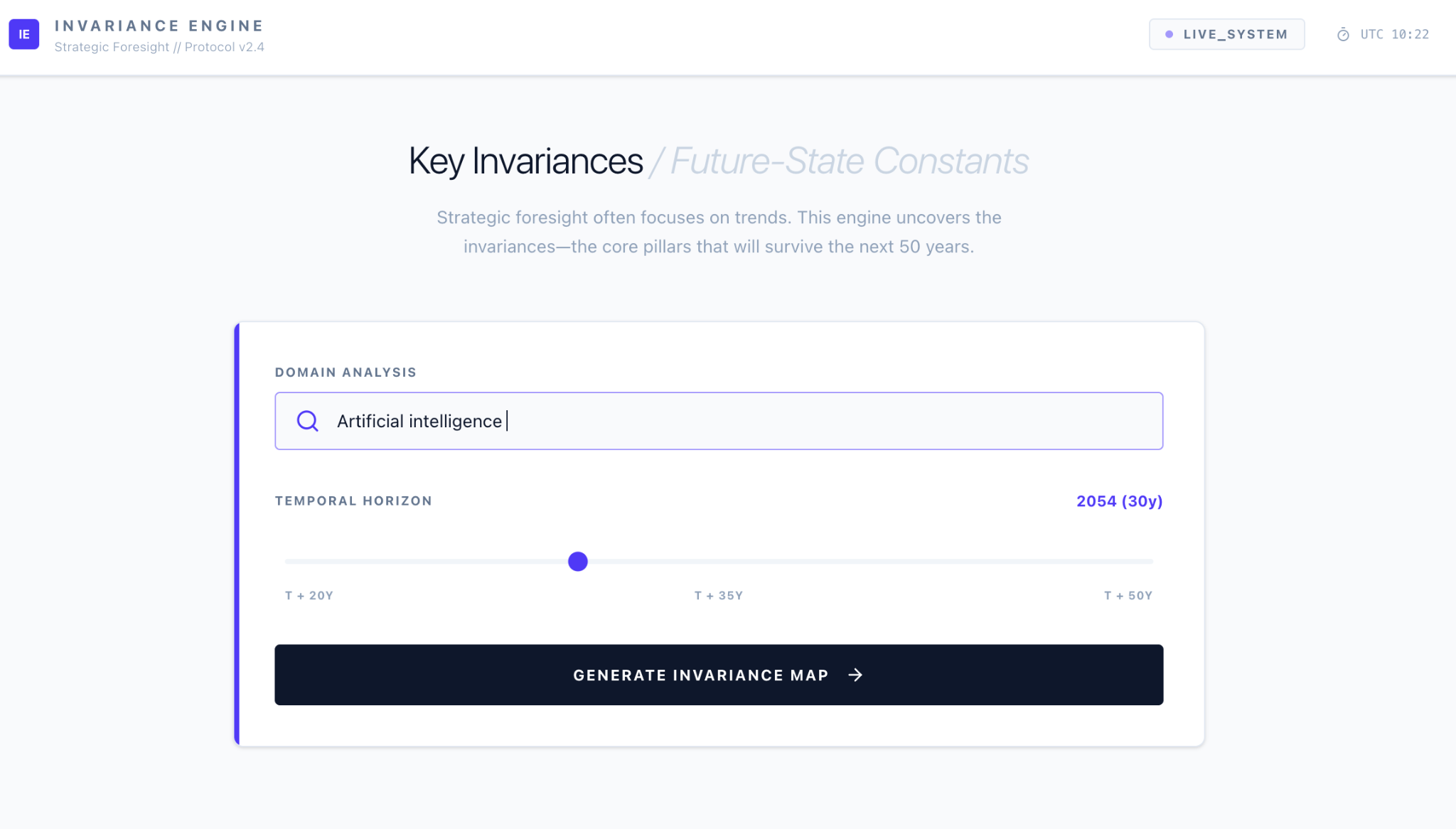
The tool takes a domain, takes horizon and then generates an invariance map - that then looks like this:

Some of these are truly interesting to think through, and agree with or disagree with – like the human trust asymmetry one - and for each of the proposed invariants we can deepen the analysis. Let’s have a look at what we see when we dig into that constant:

Now we find that where the constant breaks down we almost always will find some kind of inflection point or drastic change, so the use of invariances, then, can also be used as a tool to uncover black swans or tail-risk events that could change everything.
What we think will stay the same is really a map of where the black swans live.